
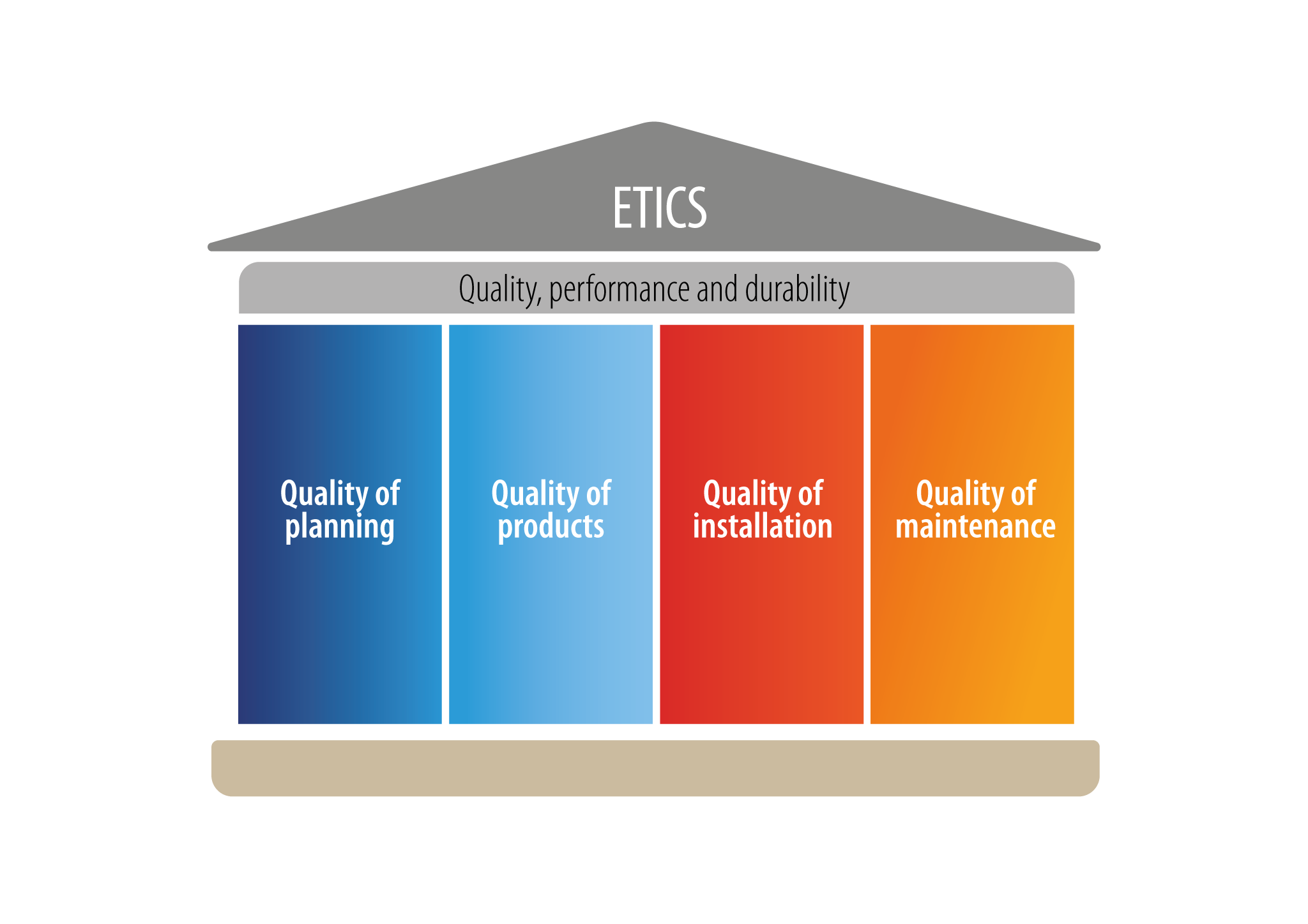
The performance of External Thermal Insulation Composite Systems (ETICS) can only be guaranteed if all ETICS kit components are supplied by one ETICS kit manufacturer (often called system holder) and installed according to its instructions. System loyalty is essential to ensure the safety, the quality, the performance and finally both the durability and sustainability of ETICS.
This has been emphasized already in European Technical Approvals Guidelines (ETAGs) and European Assessments Documents (EADs) for ETICS. Both highlighted the ultimate responsibility of the ETICS kit manufacturer. Today, it corresponds to the legal system as set out in the new Construction Products Regulation (CPR) [Regulation (EU) 2024/3110)]. It states:
- ‘construction product’ means […] any […] item […], or a kit that is placed on the market, including by means of supply to the construction site, for incorporation in a permanent manner into construction works […] [Article 3 (1)].
- ‘kit’ means a product placed on the market by a single economic operator as a set of at least two separate items, none of which needs to be a product itself, intended to be incorporated together into construction works. [Article 3 (17)]
This means: ETICS kits are one construction product comprising different components which are shipped to the construction site to be installed to external walls of a building. They are not assemblies of single products because the properties of the construction product “ETICS kit” originate from the final product, where all kit components are put together, leading to specific characteristics of the ETICS kit in its entirety.
The responsibility for the components comprising an ETICS kit and its testing lies solely with the ETICS kit manufacturer who is in charge of all obligations laid down in the CPR:
- Where a product is covered by a harmonised technical specification […], the manufacturer shall undergo the applicable assessment and verification system set out in Annex IX and draw up a declaration of performance and conformity before such a product is placed on the market. [Article 13 (1)]
- By drawing up the declaration of performance and conformity, the manufacturer assumes responsibility for the conformity of the product with its declared performance and any applicable product requirements, and becomes liable […] [Article 13 (2)]
In other words: the ETICS kit manufacturer is liable for the selection of components as only they lead to the declared kit performances. Architects, designers, installers, building owners and national regulators benefit as they can rely on the declared kit performances. In addition, the CPR obliges ETICS manufacturers to establish quality assurance measures by means of factory production control which is independently surveilled by external notified bodies. The ETICS kit manufacturer is not responsible for the installation but needs to make available information for the proper design and installation. In addition, our members offer a variety of trainings for architects, designers and installers.
Violating system loyalty by using components not explicitly foreseen by the ETICS kit manufacturer or purchased from other manufacturers, means that the Declaration of Performance (DoP) or the Declaration of Performance and Conformity (DoPC) is no longer valid and the ETICS kit manufacturer is no longer liable because it is no longer able to control the production value chain.
Hence, architects, designers or installers cannot demonstrate the compliance of the ETICS kit performance with the requirements as set out in national building codes and contractual agreements. Consequently, building owners might hold back payments and authorities might complain about infringements. Even worse, if building code requirements are not met because of not respecting system loyalty, this might impose risks for safety and health.
In the worst case, the facade cladding must be completely removed and replaced by a new ETICS kit which complies with all legal and contractual requirements. Then buying cheap immediately becomes very expensive!
The future the Digital Product Passport for ETICS will include instructions for design and installation (including the use of ancillaries for example around façade openings), information about maintenance and for the end of life. This information can today be requested from the ETICS kit manufacturer who signed the Declaration of Performance.
Thanks to this package of quality measures ETICS are safe in use, contribute to sustainability and resource-efficiency and have proven their superb durability of 50+ years in the field.
